Forgetless Obsolete
APPAI-Powered Spaced Repetition
MAR 2026

"In the age of instant answers, the real edge is remembering. If AI is the flood, Forgetless is the dam."
Discontinued. forgetless.app was taken down in 2026 and accounts and data have been removed. What follows is a record of what the product was.
Overview
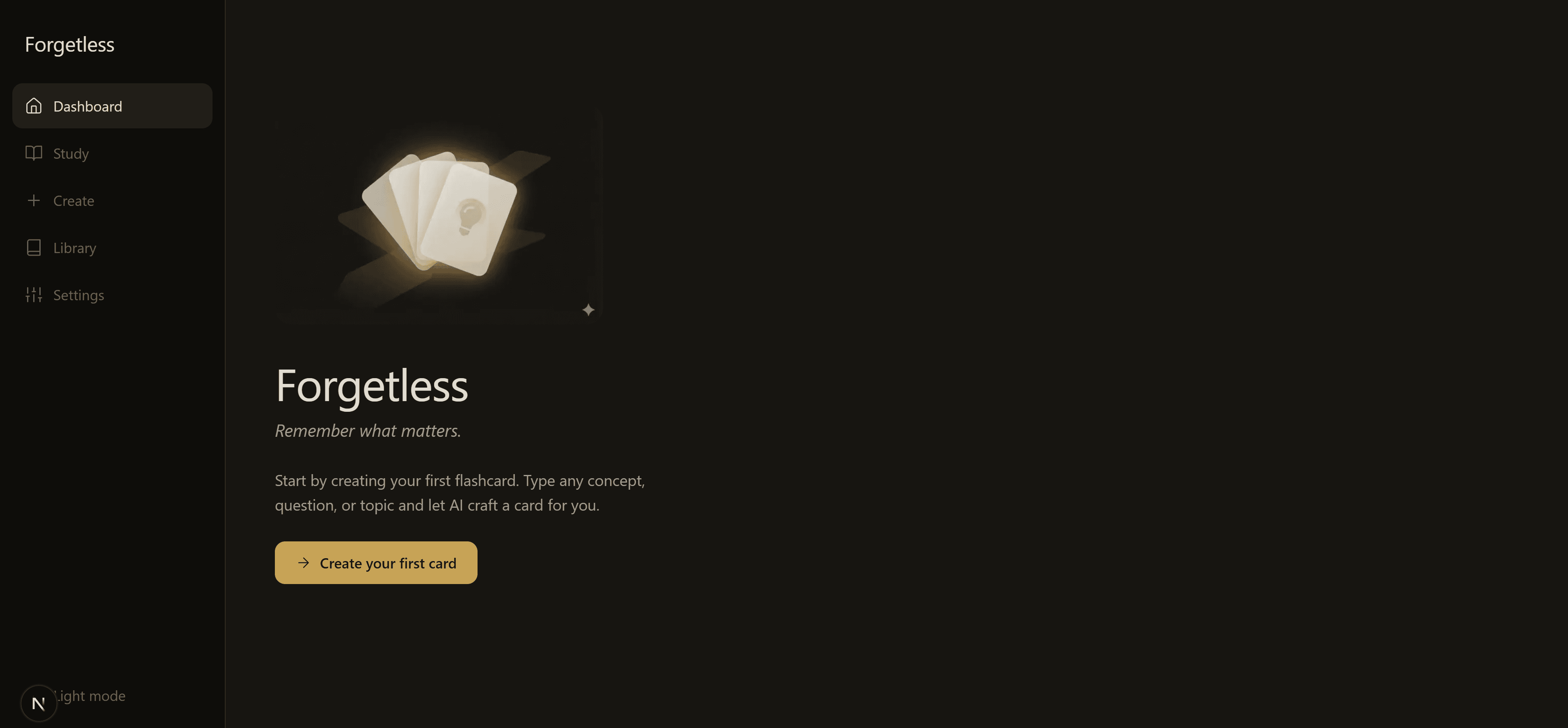
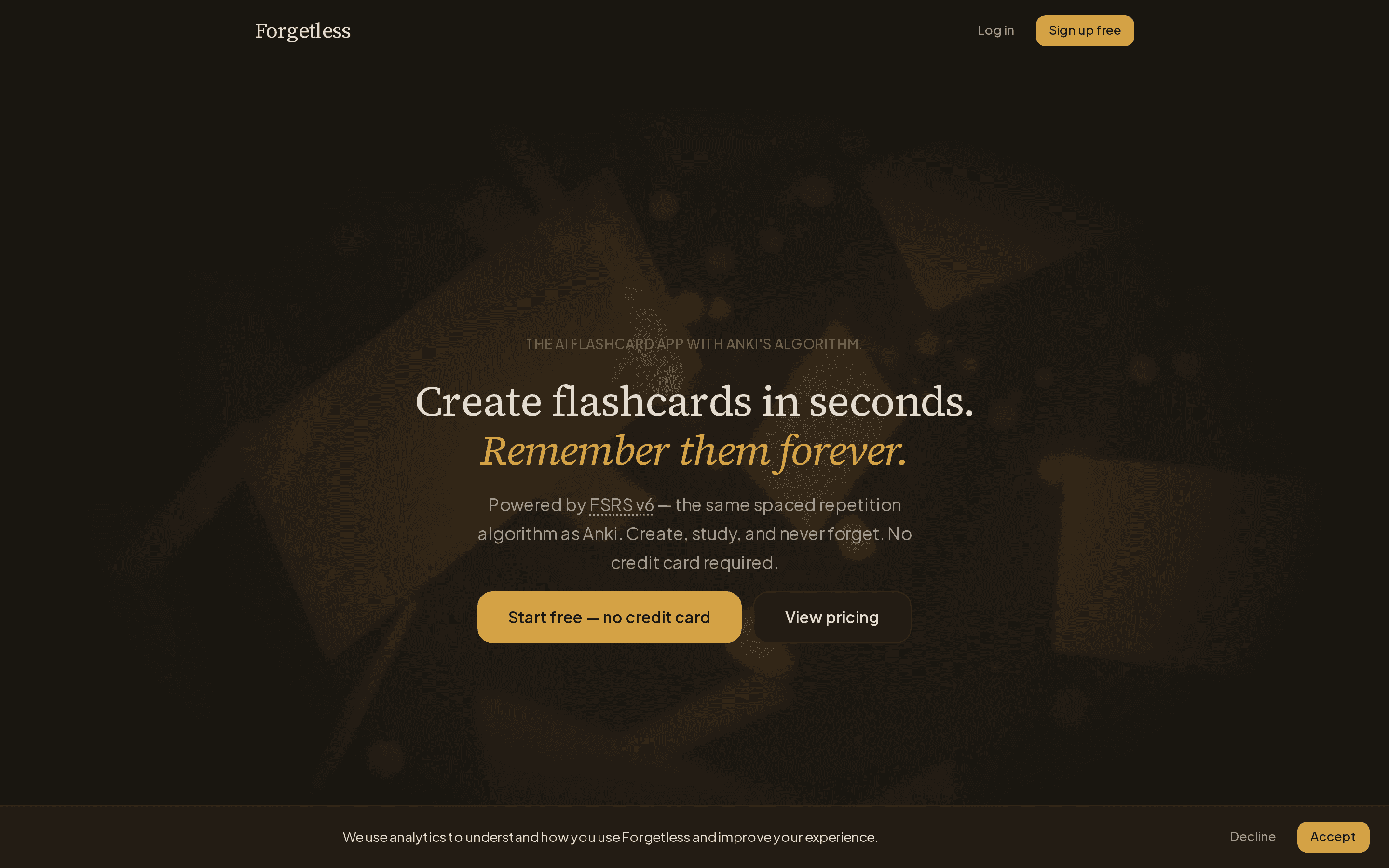
Forgetless was a production flashcard app that paired four frontier LLMs (OpenAI, Anthropic, Gemini, Mistral) with FSRS v6 — the same scientifically-validated spaced repetition algorithm used by Anki. The thesis: as generative AI commoditizes on-demand answers, durable long-term memory becomes a compounding human advantage. Forgetless turned any input — PDFs, YouTube videos, images, plain text — into memory you actually kept.
Launched publicly in early 2026 with founder pricing and a full freemium tier.
Core Value Props
1. AI card generation in 5 seconds
Type any concept; pick any of four AI providers; get a clean flashcard. Batch mode generates an entire deck from a single prompt.
2. FSRS v6 — not a toy algorithm
Runs the same Free Spaced Repetition Scheduler that powers modern Anki. Per-user parameter optimization. Landing stats: 91% average retention and 30% fewer reviews for the same recall.
3. Multi-modal input
- PDF upload → auto-generated cards from academic papers or textbooks
- YouTube transcripts → paste a URL, get flashcards from the video (Pro)
- Image upload → OCR + AI summarization
- Text input → traditional manual creation
4. Cloze deletion + card types
Inline fill-in-the-blank with word-level hiding. Fact-checking pass via Mistral on generated cards.
5. Social layer
Public deck sharing with fork-to-library, daily/weekly/staff-pick discovery, embeddable iframe widgets ("Powered by Forgetless" CTA) for blogs, Notion, and Obsidian. Anki .apkg export with watermark card.
Freemium Business Model
Free ($0 forever) — Unlimited cards, 10 AI generations/month, full FSRS engine, import/export.
Pro — Founder pricing at $9/mo (locked forever for first 100 slots). 50 AI generations/day, YouTube cards, batch generation, advanced analytics (retention curves, weak-card detection), no branding on shared decks.
Student — 50% off with academic email verification.
Tech Stack
Frontend
- Next.js 16 App Router with React Server Components
- React 19, TypeScript, Tailwind CSS
- PWA with standalone mode, custom theme color, offline-ready service worker
- Rendered via sql.js (WASM) for in-browser SQLite (Anki .apkg parsing)
Backend
- Supabase (Auth, Postgres with RLS, Storage, Edge Functions)
- 4 AI providers behind a unified abstraction: OpenAI, Anthropic, Gemini, Mistral
- FSRS v6 implementation in TypeScript with per-user parameter optimization
- Stripe (subscriptions with founder-pricing lock, student discounts, referral credits)
Ops & Growth
- PostHog for product analytics (anonymized)
- Programmatic SEO — 30+ landing pages including /compare/{anki,quizlet,remnote}, /youtube-to-flashcards, /pdf-to-flashcards, /learn/{topic}, /flashcards/{slug}
- Schema.org Course JSON-LD for every public deck, dynamic OG images
- Referral system — +25 card slots per signup, free Pro month per 3 referrals
- Creator rewards — revenue share loop for deck creators
Engineering Highlights
FSRS v6 in the browser
Anki's scheduler reimplemented in TypeScript, running entirely client-side so review latency is zero. Per-user weights are optimized from review history without sending card contents off-device.
Multi-provider AI abstraction
A single generateCard() call routes to the user's chosen provider with consistent schema, retry logic, and token budgeting. Falls back across providers if one is rate-limited.
Anki interop
Full bidirectional compatibility: import .apkg decks (parsed via SQLite WASM), export watermarked .apkg files that work in Anki Desktop, AnkiDroid, and AnkiMobile.
Rich card content
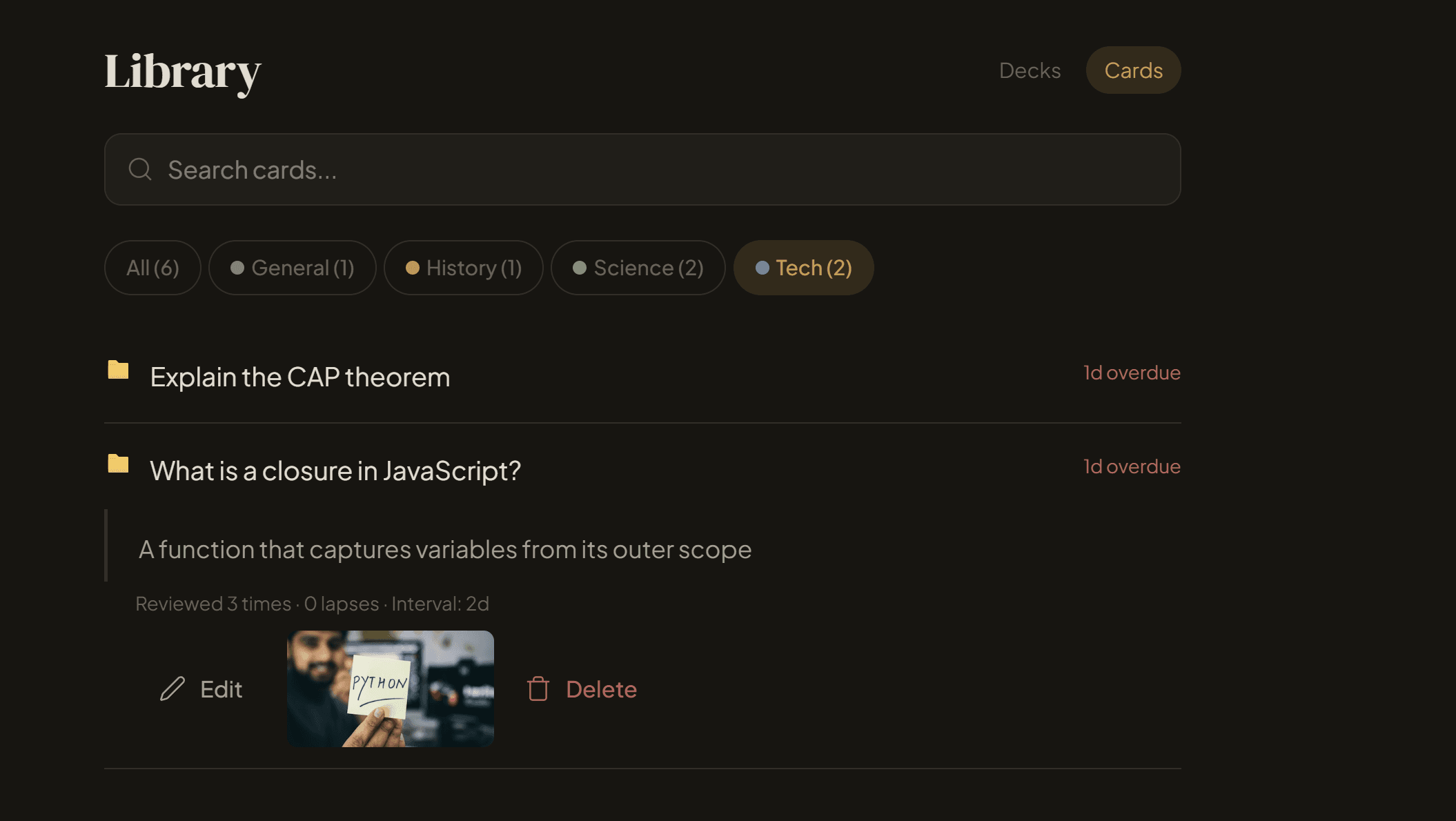
Cards render Markdown tables and Mermaid diagrams — a flashcard about system design can hold the actual diagram instead of a description of one, with node-contrast auto-detection so the diagrams stay legible in dark mode.
Guardrails on the AI bill
A global circuit breaker caps AI generation at 5,000 credits per day across all users, on top of the per-tier limits — a runaway loop or a scripted abuser can dent the day's budget, not the month's.
Shared-deck preview with soft paywall
Unauthenticated visitors can flip 10 cards + see 3 blurred cards of a shared deck before signing up. Converts curiosity into accounts without the usual hard gate.
What Made This Hard
Forgetless was not another "ChatGPT wrapper for flashcards." The hard parts:
- Getting FSRS v6 exactly right so recall matches Anki's
- Keeping AI generation costs sustainable with heavy free-tier usage (4 providers, daily limits, caching)
- Building bidirectional .apkg compatibility without breaking Anki semantics
- Shipping a PWA that feels native (iOS install, offline review, notifications)
- Solving onboarding for a non-obvious concept (spaced repetition is weird until you try it)
Why It Matters
Every knowledge worker is drowning in bookmarks they'll never re-read and summaries they'll forget. Forgetless bet that the bottleneck in the AI era isn't access to information — it's internalization. The product was small on purpose: a dam, not an ocean.