Why You Get Shocked in WinterDe ce te curentezi iarna
APPAPLICAȚIEStatic at the OfficeElectricitatea statică de la birou
NOV 2026NOV. 2026
Overview
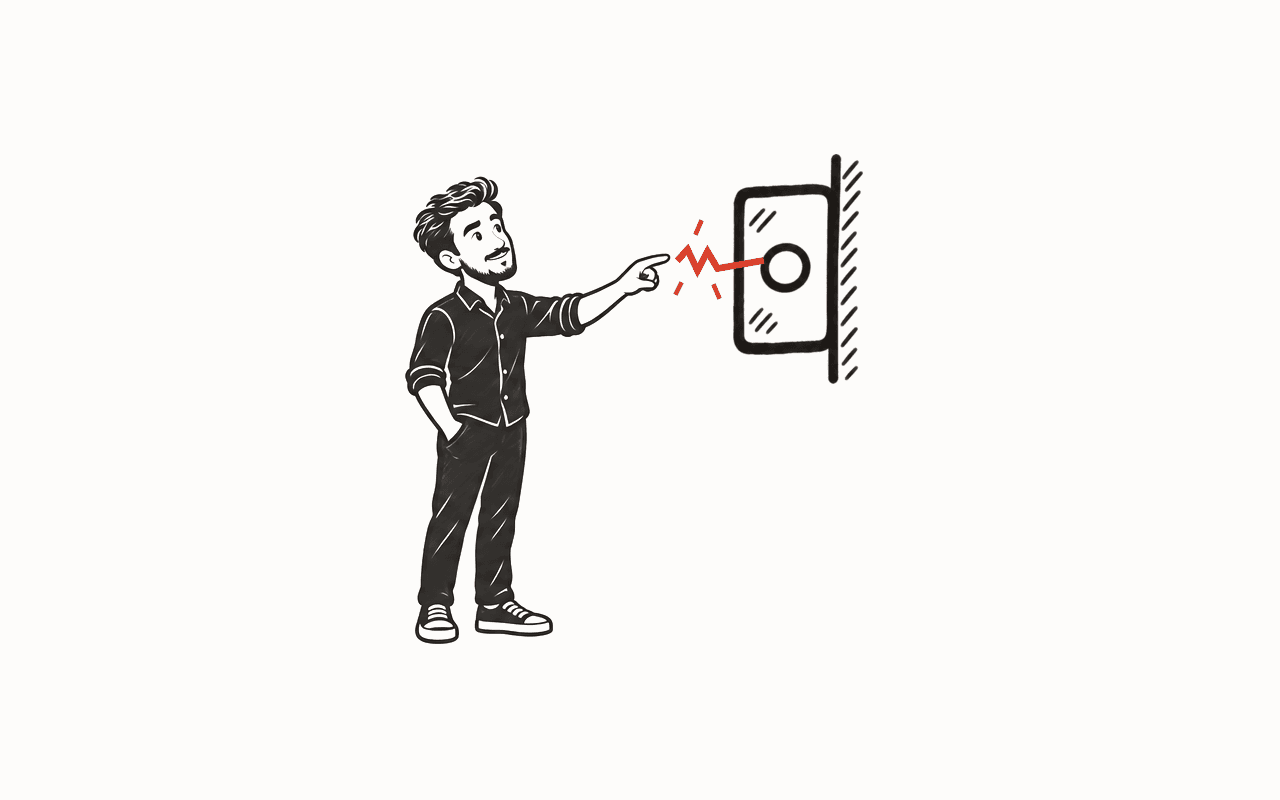
Every winter the same thing happens at my office: the lift button bites, the laptop's ports bite, a colleague's arm bites. In summer, nothing, and even in winter only when I haven't been shocked for a while. All three are static electricity. The page explains it in nine steps, in two parts: where the charge comes from and why winter lets it pile up, then what happens in the last millimetre before a finger touches metal.
Part one: where the charge comes from
- You charge up without noticing. Shoe soles and carpet, a back and a chair: two materials that touch and part swap a few electrons. Walk on carpet, parquet or an antistatic floor and watch your voltage climb (or not), with the number of extra electrons on you.
- The charge also leaks away. Your voltage climbs fast, then slower, and levels off at a plateau where each step adds as much as leaks away. The plateaus are published measurements, HP's table at 10, 40 and 55% humidity (35,000, 15,000 and 7,500 V on carpet) and the ESD Association's damp end; between them the page draws a model and says so.
- Why winter. Humidity is a share, not an amount: one glass as wide as the water the air can hold at its temperature, in grams, with the water it really carries. Bring a damp 0 °C day at 80% into the office and the glass widens at 21 °C: the same 4 grams fill about 20%.
Part two: the spark
- Why only metal. A fingertip approaching the lift button or a wooden desk: near metal the field passes what air can hold (about 3 kV per millimetre across wide gaps, a little more across a millimetre or two), the air starts to conduct, and a spark jumps about 1.5 mm before the skin touches.
- Sharp or rounded. A metal rod at 6,000 V whose end goes from a generator's ball through a fingertip to a needle point: the field at a round surface is its voltage divided by its radius, the charge crowds at the end, and a red shell shows where the air conducts.
- What you feel. Feel from about 3,000 V (many people from 2,000), see from 5,000, hear clearly from 6,000; in the human-body model, the peak current and the energy, a few millijoules.
- Other people. You and a colleague: hold a button and either of you walks and charges up; touch hands and one spark splits the difference.
- Your office. Walk, sit and shift, stand still; touch the lift, the laptop, the colleague or the desk. A second touch right away does nothing, which is why it only bites after a while; sitting at the desk charges you too, which is why the laptop can bite again without you getting up.
- What you can do. The same office with a key in hand: the spark jumps from the key, and you feel nothing.
How it is built
- One pure physics module: the measured plateaus with a log-linear model between them, the antistatic floor's 100 V limit, the Magnus formula for indoor humidity, the spark gap, the field at a curved surface, the human-body model's energy and current, and the touch rules, each constant next to its source
- A tested reducer for the office board, with my own cases as tests: the lift after walking, the laptop again while sitting, the second touch that does nothing, the key
- Objects drawn as SVG in the site's marker style (the bucket, the jars, the hand, the lift, the desk, the laptop, the chair), so they stay crisp at any size and follow the theme; the people are my caricature
- A layout test that plays every board at phone and desktop widths, in both languages, and fails on a label cut off, two labels on top of each other, a label half under a drawing, or a person drawn over a thing
Simplified on purpose
Charging is an exponential approach to the plateau, two people are equal conductors, and the spark gap uses the field of a flat gap. Real numbers vary with shoes, clothes, floors and people.
Pe scurt
În fiecare iarnă se întâmplă același lucru la birou: mă curentează butonul liftului, porturile laptopului, brațul unui coleg. Vara, nimic, și nici iarna nu de fiecare dată, ci doar după ceva timp în care nu mi s-a întâmplat. Toate trei sunt electricitate statică. Pagina o explică în nouă pași, în două părți: cum te încarci și de ce iarna o lasă să se adune, apoi ce se întâmplă pe ultimul milimetru înainte ca degetul să atingă metalul.
Partea întâi: cum te încarci
- Te încarci fără să-ți dai seama. Tălpile și mocheta, spatele și scaunul: două materiale care se ating și se despart schimbă câțiva electroni. Mergi pe mochetă, pe parchet sau pe o podea antistatică și vezi cum îți crește tensiunea (sau nu), cu numărul de electroni în plus de pe tine.
- Sarcina se și scurge. Tensiunea urcă repede, apoi mai încet, și se oprește la un palier unde fiecare pas adaugă cât se scurge. Palierele sunt măsurători publicate, tabelul HP la 10, 40 și 55% umiditate (35 000, 15 000 și 7 500 V pe mochetă) și capătul umed de la ESD Association; între ele, pagina desenează un model și spune asta.
- De ce iarna. Umiditatea e un procent, nu o cantitate: un pahar cât de multă apă poate ține aerul la temperatura lui, în grame, cu apa pe care o are de fapt. Adu în birou o zi umedă, la 0 °C și 80%, și paharul se lărgește la 21 °C: aceleași 4 grame umplu cam 20%.
Partea a doua: scânteia
- De ce doar metalul. Un vârf de deget care se apropie de butonul liftului sau de un birou de lemn: lângă metal, câmpul trece de cât suportă aerul (cam 3 kV pe milimetru pe distanțe mari, ceva mai mult pe un milimetru sau doi), aerul începe să conducă și o scânteie sare de la circa 1,5 mm, înainte ca pielea să atingă.
- Ascuțit sau rotunjit. O tijă de metal la 6 000 V al cărei capăt trece de la bila unui generator, prin vârful degetului, la un vârf de ac: câmpul la o suprafață rotundă e tensiunea împărțită la rază, sarcina se înghesuie la capăt, iar o zonă roșie arată unde conduce aerul.
- Ce simți. O simți de pe la 3 000 V (mulți de pe la 2 000), o vezi de pe la 5 000, o auzi limpede de pe la 6 000; în modelul corpului uman, curentul maxim și energia, câțiva milijouli.
- Alți oameni. Tu și un coleg: ții apăsat un buton și unul dintre voi merge și se încarcă; vă atingeți mâinile și o singură scânteie împarte diferența.
- Biroul tău. Mergi, stai și te miști pe scaun, stai pe loc; atingi liftul, laptopul, colegul sau biroul. A doua atingere imediată nu face nimic, de asta te curentează doar din când în când; și statul la birou te încarcă, de asta laptopul te poate curenta din nou fără să te ridici.
- Ce poți face. Același birou, cu o cheie în mână: scânteia sare din cheie și nu simți nimic.
Cum e construit
- Un singur modul de fizică pur: palierele măsurate cu un model log-liniar între ele, limita de 100 V a podelei antistatice, formula Magnus pentru umiditatea din birou, distanța de scânteie, câmpul la o suprafață curbată, energia și curentul din modelul corpului uman și regulile atingerii, fiecare constantă lângă sursa ei
- Un reducer testat pentru tabla biroului, cu propriile mele cazuri ca teste: liftul după mers, laptopul din nou cât stau pe scaun, a doua atingere care nu face nimic, cheia
- Obiecte desenate în SVG, în stilul de marker al site-ului (găleata, borcanele, mâna, liftul, biroul, laptopul, scaunul), ca să rămână clare la orice mărime și să urmeze tema; oamenii sunt caricatura mea
- Un test de așezare care joacă fiecare tablă pe telefon și pe desktop, în ambele limbi, și pică dacă un text e tăiat, două texte se suprapun, un text intră sub un desen sau un om e desenat peste un obiect
Simplificat intenționat
Încărcarea e o apropiere exponențială de palier, doi oameni sunt conductori egali, iar distanța de scânteie folosește câmpul dintre două suprafețe plane. Cifrele reale variază cu pantofii, hainele, podelele și oamenii.

New explanations, by emailExplicații noi, pe email
I draw how everyday things work, one step at a time, and you can play with every drawing. The newest is why you get shocked in winter; before it, how WiFi gets through walls. Leave your email and I’ll write only when a new one is out.Desenez cum funcționează lucrurile de zi cu zi, pas cu pas, și te poți juca cu fiecare desen. Cea mai nouă e de ce te curentezi iarna; înainte de ea, cum trece WiFi-ul prin pereți. Lasă-mi emailul și îți scriu doar când apare una nouă.
Only for new explanations. I don’t share your address, and every email has a one-click unsubscribe.Doar pentru explicații noi. Nu dau adresa nimănui, iar fiecare email are dezabonare dintr-un clic.